
A Semester in Chapters: Learning Across MDI’s Fall 2025 Workshops
By: Bhumika Nebhnani, MPP ’27, Fall 2025 MDI Communications & Events Assistant
Each semester, the Massive Data Institute (MDI) brings the Georgetown community together to explore new ways of understanding data, people, and technology. This Fall, the workshops felt like chapters in a shared journey, one that carried the participants from the fundamentals of human-centered artificial intelligence (AI) all the way to the logic of cryptography. Across all five workshops led by MDI postdoctoral fellows, the participants learned, questioned, and reflected together.
Chapter 1: Research Methods for Human-Centered AI (Sept 23)
The semester opened with Eric Zeng, Ph.D.’s workshop on “Research Methods for Human-Centered AI?” in which he guided participants through the process of answering such questions when no dataset exists–by building one. Through an elaborate discussion on qualitative coding, survey design, experiment planning, IRB considerations, and statistical analysis, attendees learned how to study technology by studying people. For many, it was their first introduction to the full arc of running online human-participant research. Sazan Khalid, a Fall 2025 MDI Scholar, reflected on the session, noting that the small-group discussion involving participants drafting research questions and carving out methods for answering them was particularly valuable. “That exercise gave me a much clearer sense of how to develop a paper-ready research question,” Sazan shared. She added, “I now find myself applying this framework as I begin drafting potential research projects. The workshop also deepened my understanding of the ethical considerations involved in conducting human-centered research.”
Chapter 2: Network Analysis Methods Across Disciplines (Oct 7)
Two weeks later, the focus shifted from individuals to connections for “Network Analysis Methods Across Disciplines” led by Melissa Collier, Ph.D. Participants learned to transform raw datasets into meaningful networks. Yuxi Shen, another Fall 2025 MDI Scholar, remarked:
“The hands-on sample code (especially using Python/NetworkX) helped me understand how to construct a network from real data and interpret measures like centrality/community structure. I can see myself applying these tools to analyze relationships and interaction patterns in my own research datasets.”
With examples spanning public health, social science, and ecology, Dr. Collier showed how the relationships between people, species, or communities can reveal patterns that traditional methods miss. As participants built visualizations in Python and interpreted key metrics, the workshop became a moment of realization: Once you learn to see networks, you start seeing them everywhere.
Chapter 3: Understanding Textual and Visual Reasoning Through Generative Models (Oct 20)
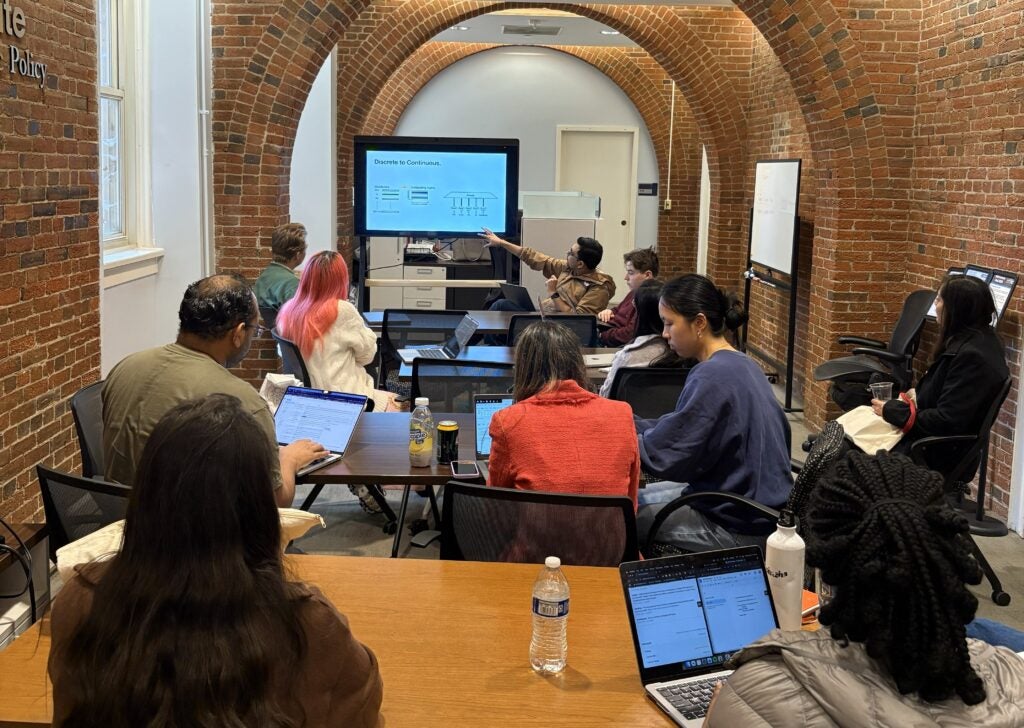
Rupayan Mallick, Ph.D. stepped directly into the frontier of multimodal AI for the third workshop “Understanding Textual and Visual Reasoning Through Generative Models”. Through real-world examples, from interpreting medical scans to reasoning over complex visual scenes, Dr. Mallick explained how contemporary models integrate images and language. Participants examined both the promise and the limitations of these systems: their ability to explain, compare, and infer; their susceptibility to hallucinations; and the broader implications for trust and fairness. The session combined technical clarity with deeper philosophical inquiry, encouraging attendees to reflect on how machines “see” and “reason.”
Reflecting on the workshop, Abhishek Purushothama, a Computer Science PhD student at Georgetown, shared:
“Dr. Mallick provided us with a workshop that was accessible, building toward current generative models from the principles of deep learning and neural networks. I learned a lot from the exploration of links between text models, vision models, and vision–language models. The highlight for me was the content about textual and visual reasoning with these models, both the strengths and limitations. After the workshop, I am looking forward to exploring how structures of meaning can represent and interact with visual information in my future research.”
Chapter 4: Designing for Real People (Nov 11)
From technical reasoning, the series moved toward design. In “Designing Human-Centered AI and Digital Tools”, Dr. Sejin Paik commenced the workshop with drawing the difference between tech-centered and user-centered approaches. This built the theoretical base for application of Human-Centered Design in products. As Sanguen Lee, a first year MPP student says,
“I loved how the workshop used the CommuniTies case to demonstrate that successful tech design starts with understanding community needs, not just technological capabilities. The comparison between techno-determinism and socio-technical approaches gave me a practical framework for evaluating any digital tool moving forward. It’s opened my eyes to how I’ll approach designing AI and digital tools for diverse communities.”
The third part of the workshop involved an interactive ideation by participants. For their chosen problem, they mapped user needs, translated them into design requirements, and imagined how their research could become usable tools for real communities. Social science students found an unexpected entry point into product thinking, while engineering students gained a deeper appreciation for designing with, not just for, users. Overall, as Liam Mason writes, “Sejin did a great job explaining the concepts behind HCD and various business cases. I particularly loved the ideation portion of the workshop.”
Chapter 5: Protecting Data, One Cipher at a Time (Nov 18)
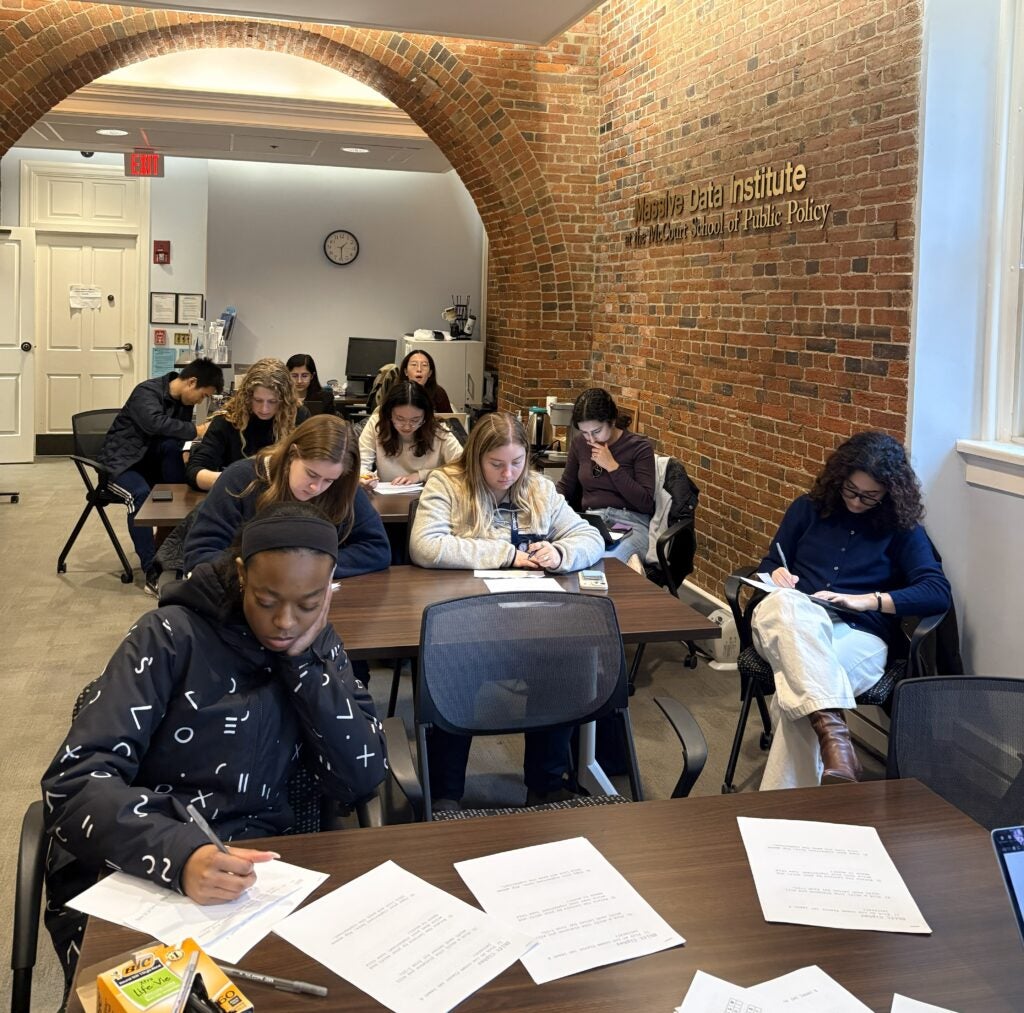
The final workshop of the semester, “Privacy Through Cryptography” with Lucy Qin, Ph.D., took participants into the world of secure communication. From foundations involving brute force attacks, all the way to modern cryptosystems like secure multi-party computation, the workshop involved hands-on learning exercises by the participants. Candance Huntington, a Graduate Student in the Security Studies Program, reflected on the experience:
“I had little to no background in cryptography, and the workshop introduced it in such an accessible way. The exercises made each method come alive and helped me see how different ciphers provide different layers of security.”
As participants decrypted messages and uncovered vulnerabilities, the logic behind modern encryption methods emerged clearly. Peixuan (Peipei) Ji, an M.S. student in Computational Linguistics, added:
“I always assumed cryptography would be heavy computer science, but this workshop made it fun and intuitive. I loved seeing how formal logic and semantics connect to real-world encryption.”
As the Fall 2025 series ended, one theme emerged across all five workshops: MDI is not just teaching methods; it is nurturing inquisitiveness. Spring 2026 workshop details will be announced soon on the MDI website.
- Tagged
- Fellows
- MDI Workshops