
Civic Technology and the Institutionalization of Human-Centered Data
By: Miranda M. Yarowsky, SFS ’26, Fall 2025 MDI Program Assistant
The accelerating digitization of government presents not only an extraordinary opportunity for humanity but also a profound ethical test. On November 4, the Beeck Center for Social Impact + Innovation hosted Civic Tech Live, featuring Dr. DJ Patil who served as the first U.S. Chief Data Scientist from 2015 to 2017.
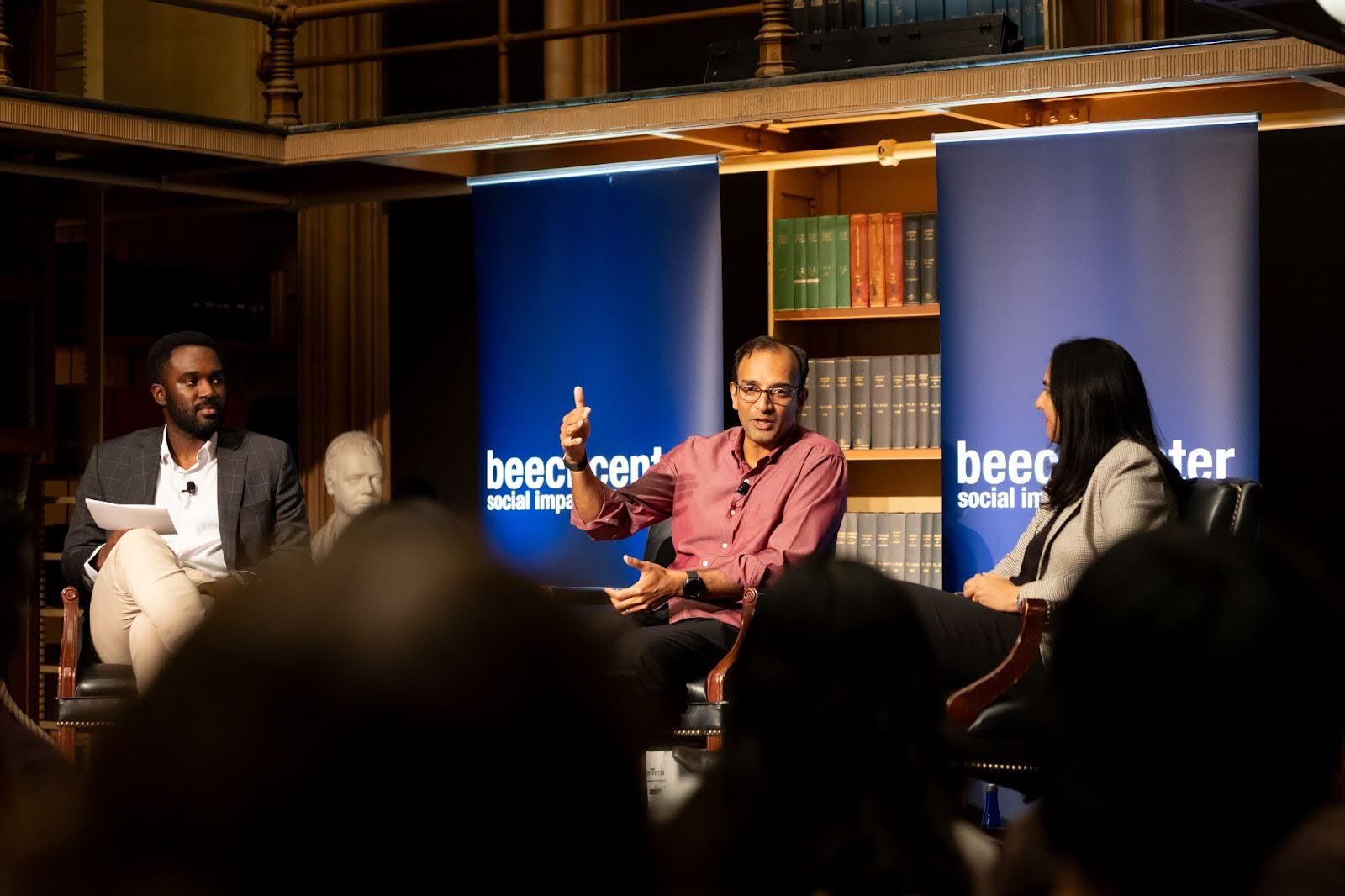
Patil reminded the audience that “the best data problems are human problems”. His conversation with Dr. Lisa Singh, Director of Georgetown’s Massive Data Institute, explored how the next generation of data leaders must continue to balance innovation with moral reasoning. Together, they reflected on the evolution of civic technology and its potential as an institutional force to reshape public life.
Building Infrastructure for Impact
Appointed by President Obama, Patil led landmark initiatives such as the Precision Medicine Initiative, the Cancer Moonshot, and the Police Data Initiative, which are programs that reoriented federal data toward public benefit. As Tuqa Alibadi (SFS ’27), a Beeck Center Student Analyst, noted in her opening remarks, Patil “didn’t just run projects; he built infrastructure for impact”.


Left: Student Analyst Tuqa Alibadi. Right: (left to right, on stage) Student Analyst Walter Hall, Dr. DJ Patel, and Dr. Lisa Singh
Under the Obama Administration, Patil’s leadership as Chief Data Scientist emphasized both civic and technical priorities while simultaneously ensuring that data stewardship would still persist beyond his tenure. He sought to embed data governance as a durable function of democracy itself. For Patil, “civic tech” must move beyond rhetoric toward systemic reform, to transform the ideals of transparency and accessibility into real, operational realities.
Dr. Singh added to Patil’s assertions by reframing this vision through an ethical lens. As a trained computer scientist specializing in data mining, Singh frequently works with “messy” datasets. The everyday reality of data, which is often information that arrives incomplete, inconsistent, or poorly structured, forces the analyst to slow down and clean the data before drawing conclusions. To Singh, the messiness of data is not a flaw but a moral condition that also demands humility from the analyst. She cautioned against the uncritical adoption of generative artificial intelligence (AI), emphasizing that “it’s easy to create a model and not test it”.
Singh offered a clever analogy by comparing AI to driving a car. She asserts that citizens need not understand every component of the engine but should at least know that an engine exists. This captures a central tension in civic technology, which is that meaningful engagement with AI requires a sense of technical fluency and ethical literacy.

(left to right) Dr. DJ Patel and Dr. Lisa Singh
Human-Centered Design as Cultural Practice
Both speakers emphasized that the greatest challenge of human-centered data is not solely technical but also contextual. Patil recounted a formative experience he had as part of a justice data project visiting a jail and asking inmates what they wished the President knew. That encounter, he explained, “flipped [his] order of thinking”. He realized that the true blind spot of civic tech lies in its distance from lived experience. Hearing inmates describe their realities forced Patil to confront how far civic technology can sit from the realities of the people it aims to serve. Their responses exposed a gap between the datasets he routinely analyzed and the human experiences those numbers were meant to reflect. That moment made him recognize that human-centered design is a moral imperative and that technology must begin with the perspectives of those most affected by it.
Meanwhile, Dr. Singh asserted that ethics must be embedded directly into the data science curriculum in order to help students develop into scientists who apply the same rigor and importance to understanding concepts such as bias and accountability as they do to learning how to code. Despite differences in priorities, both perspectives come together around a clear goal: to close the gap between technology and the people it is meant to serve.
Institutions that Bridge People and Policy
At Georgetown, the Beeck Center and the Massive Data Institute are where this vision takes shape. For Patil and Singh, the next generation of civic technologists, or what Patil affectionately called “the next generation of awesomeness”, will not be defined by their ability to process massive data sets, but rather by their capacity to translate human experience into data-informed action.
The MDI Scholars Program is one of the clearest examples of this mission in action. Each semester, MDI Student Scholars partner with researchers or policymakers to use data for public good. Whether this consists of creating data visualizations to show the relationship between U.S. school spending and student outcomes or evaluating state-level AI readiness via the incentives and regulations on AI, these projects give students an exclusive opportunity to see how data can be used in evidence-based policy.
Applications are now open for the Spring 2026 cohort, for more information apply here.
Honoring the Legacy of Erica Pincus
This event was made possible through the generous support of the Erica Pincus Arabesque Foundation, in loving memory of Erica Pincus (SFS ’13). During her time as a Policy Advisor and Special Assistant in the Obama White House Office from 2015 to 2017, Erica worked closely with both DJ Patil and Lynn Overmann, Executive Director of the Beeck Center. The event was supported by her parents, Holly Seirup Pincus and Cliff Pincus, whose enduring commitment to the Foundation and to Georgetown continues to advance the work she championed.

Lynn Overmann, Executive Director of the Beeck Center for Social Impact + Innovation at Georgetown University, delivering her remarks and reflecting on Erika’s lasting impact.
In remembering Erica, we also remember how deeply passionate she was about developing technology-enabled, data-driven, and user-centered solutions to society’s toughest challenges. Her legacy lives on through events like Civic Tech Live, which continue to ask how we can build technology that is socially responsible.